Report on African-Amerian Heritage Month Symposium on Buffalo Soldiers
Sponsored by the Friends of the Ferguson Home held at the Watonga Public Library
Feb. 19, 2026
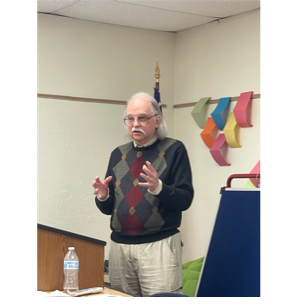
Professor Roger Hardaway presents
The Friends of the Ferguson Home invited Prof. Roger Hardaway of Northwestern Oklahoma State University in Alva to present again this year. His major topic last year was African American Cowboys. This year we asked him to present on African American soldiers serving in the Congressionally created IX and X Cavalry. These were all Black soldiers serving after the Civil War, primarily west of the Mississippi River. They were lead by white officers, but did have African American leaders such as Capt. Flipper, the first African American graduate of West Point.
2nd Lieutenant Henry O. Flipper
Flipper served at Ft. Sill while awaiting to join his unit. His engineering work to drain a malarious area on the Fort are still evident on the 18th hole of the golf course. He was posted at Ft. Eliot on the Texas side of the Ok. Texas Panhandle. One of his feats was to create a telegraph system between Ft. Elliot and Ft. Supply, OK. He was later stationed with his men at Ft. Davis, TX where he was accused of mismanagement of government funds and dismissed from the military. Pres. Clinton gave him a full pardon post-humously.
Chaplains teach soldiers
Other officers were Chaplains. They taught many African Americans to read and write. Allen Allensworth of the 24 Infantry developed teaching materials for illiterate soldiers. In all, Prof. Hardaway mentioned six Chaplain officers. He also mentioned about 8 officers of the cavalry or infantry who rose to high ranks.
African Americans proved themselves
His theme was that African Americans had to prove their value and reliability in the Revolutionary War, Civil War, WW 2 and as soldiers post-Civil War as exemplary cavalry and infantry.
Bootleggers, cattlemen and native Americans
One of the jobs of the Buffalo Soldiers was to keep bootleggers and unauthorized cattlemen out of present day Oklahoma. They also helped manage native Americans on the reservations. Prof. Hardaway found it ironic that the US used one minority group (African-Americans) to manage another minority group (Native Americans).
The lecture was attended by about 17 persons.
Special thanks
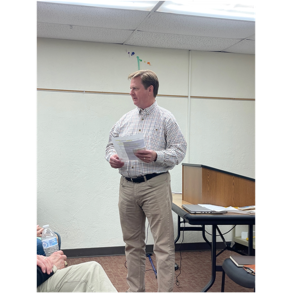
Special thanks to Teresa Bryan who provided cookies and drinks. Thank you to Todd Lafferty for Introducing the Speaker. Also, special thanks to the WPL for use of the conference room and audiovisual system. And thanks to the several Cheyenne-Arapaho members/leaders who attended. Also, thank you to Roy Espy who recorded the lecture.
Joe P. Bryan, Secretary, Friends of the Ferguson Home

0 Comments